The sea was calm. Too calm.
You are on your lucky chair, staring at your portfolio like a fisherman gazing at still water—no ripples, no clues, just uneasy silence. The sea didn’t warn anyone. One moment it was calm—charts moving lazily, portfolios breathing easy, investors sipping tea and checking green numbers. Next, the sky cracked open. News flashed across screens: escalating geopolitical tensions.
Oil spiked, gold glittered, and stocks trembled like leaves in a storm.
And just like that, the ocean turned hostile.
But here’s the truth no one tells you:
In markets like these, you are not the fisherman. You are the fish.
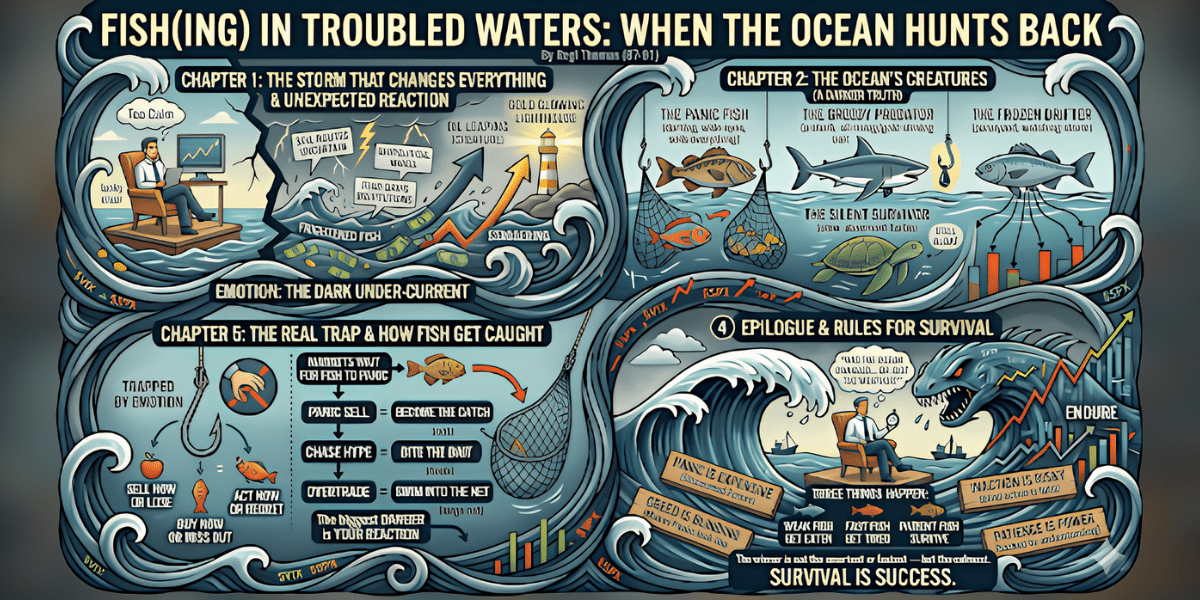
Chapter 1: The Storm That Changes Everything
When geopolitical waves crash—they don’t just disturb borders, they disturb behavior. Oil routes become uncertain, fear grips institutions, and suddenly billions of dollars begin to move like a school of frightened fish.
The market doesn’t whisper. It roars.
Oil prices leap like a creature escaping the deep. Gold glows, drawing investors toward it like a lighthouse in the dark. Stocks don’t just fall—they stagger, confused between fear and hope.
And in this chaos, something far more dangerous than war emerges:
Emotion. It’s like someone shook the entire ocean—and every fish is now swimming frantically.
Chapter 2: The Ocean’s Creatures (A Darker Truth)
Look closely beneath the surface. You’ll see them.
The Panic Fish. Eyes wide. Heart racing. It feels the current shift and darts wildly. Sell everything. Escape. Survive. But in its frenzy, it swims straight into the net.
The Greedy Predator. It smells of opportunity. Is oil rising? Is gold shining? It lunges. Hard. Fast. But even sharks misjudge. It bites the hook hidden inside the bait.
The Frozen Drifter. Paralysed. Watching. Waiting. Hoping the storm will pass. But the ocean doesn’t wait. It drags the still ones into the depths.
The Silent Survivor. Slow. Observant. Almost invisible. It doesn’t fight the storm. It moves with it. And when the chaos fades, it is still there, like a silent turtle.
Chapter 3: The Illusion of Immediate Danger
Here’s what makes the storm terrifying: it feels permanent.
The news screams. Experts debate. Charts bleed. Every second feels like a decision must be made—or disaster will strike.
But history whispers a different story.
Storms in the market are violent—but rarely eternal. They rise fast, peak in fear, and fade into memory.
Yet most investors don’t drown because of the storm.
They drown because they forget how to swim.
Chapter 4: The Currents Beneath the Chaos
Every storm has invisible forces pulling at you—ocean currents that need to be decoded.
Oil erupts first—like fire beneath water. Energy stocks dance wildly, but the heat burns late entrants.
Gold becomes the illusion of safety—crowded, glowing, tempting, but often overbought when you arrive.
Stocks behave like waves—crashing hard, then quietly rebuilding strength beneath the surface.
Cash becomes oxygen—the one thing that lets you stay calm while others suffocate.
The ocean is not random. It is a reaction layered on a reaction.
Chapter 5: The Real Trap (And How Fish Get Caught)
You think the crisis is the enemy?
It’s not.
The real predator is invisible. Silent. Patient.
It waits for fear. It feeds on urgency. It thrives on your need to do something.
That predator is your own decision-making under pressure.
Markets don’t trap you with force. They trap you with temptation.
—Sell now or lose everything.
—Buy now or miss out forever.
—Act now or regret later.
Every one of these is a hook. And most investors bite.
The biggest danger is not the war.
It’s your reaction to it.
Markets are like expert fishermen. They don’t chase fish—they wait for fish to panic.
When you panic sell: you become the catch.
When you chase hype: you bite the bait.
When you overtrade: you swim into the net.
The trap is emotional decision-making.
Chapter 6: You in the Eye of the Storm
You watch it all unfold. The red numbers. The breaking news. The chaos.
Your phone buzzes nonstop—friends selling, experts shouting, social media predicting doom.
For a moment, you feel it. The pull. The urge to act.
But then… you pause.
Not out of fear. But out of clarity.
You ask yourself one question:
“Has the ocean changed… or just the weather?”
And in that moment, everything shifts.
You don’t dump your strong stocks. You don’t chase oil at its peak. You don’t run toward gold like a crowd chasing safety.
You do something far more difficult.
You stay still… when everything demanded movement!
Chapter 7: The Brutal Rules of Survival
If you want to survive troubled waters, you must accept a harsh truth:
The market rewards discipline, not drama.
So remember:
Panic is expensive—it sells your future at a discount.
Greed is blinding—it makes peaks look like beginnings.
Inaction is risky—but blind action is fatal.
Patience is power—but only if backed by understanding.
The goal is not to avoid storms.
The goal is to outlast them.
Chapter 8: When the Storm Passes
Because it always does.
The waves calm. The noise fades. The headlines move on.
And what remains?
Not the fastest fish. Not the loudest. Not the most aggressive.
But the ones who understood something deeper:
The ocean was never the enemy. Their reaction to it was.
Epilogue: The Quiet Power of Staying Afloat
There will always be another crisis. Another war. Another reason for markets to shake you.
You cannot control the storm. You cannot silence the waves.
But you can choose one thing:
How do you move when everything else loses control?
In every storm, three things happen:
—Weak fish get eaten.
—Fast fish get tired.
—Patient fish survive.
The winners are not the smartest or fastest—but the calmest.
And in investing, survival is success.
So when the waters darken again—and they will—remember this:
Don’t thrash. Don’t chase. Don’t freeze.
Just breathe. Observe. Endure.
Because in the end…
The ocean doesn’t decide your fate. Your instincts do.
The ocean will always have storms—wars, crises, panic, headlines.
But remember:
You are not here to predict the storm. You are here to survive it.
So don’t swim wildly. Don’t chase shiny bait.
Stay steady. Stay patient.
And most importantly—
Don’t become the fish.