
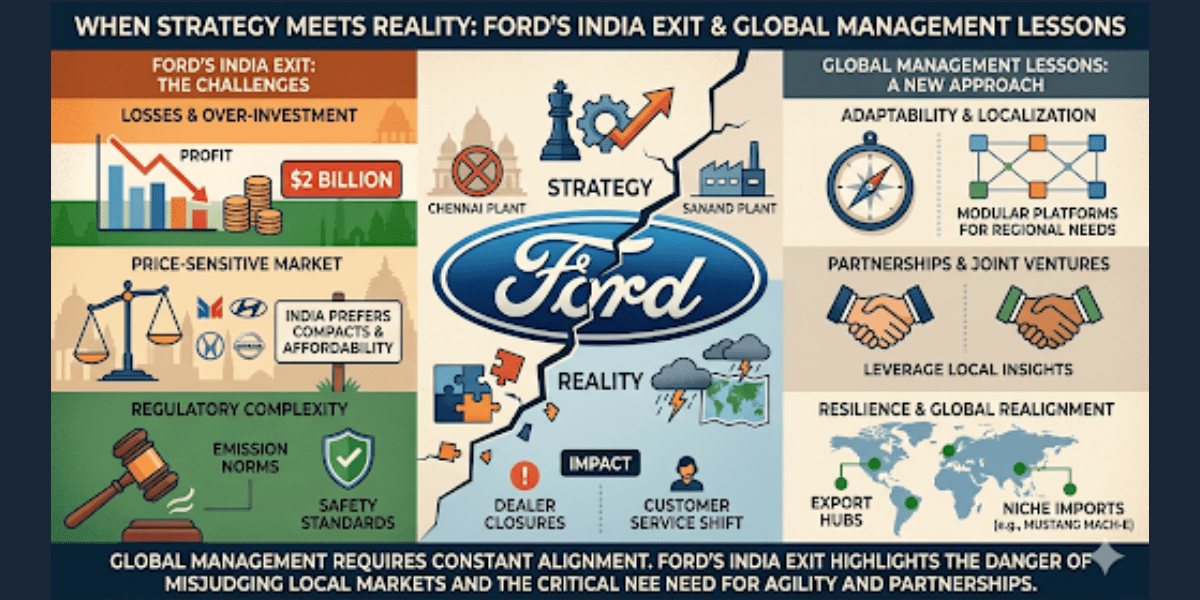
In the March–April 1999 issue of Harvard Business Review, Ford Motor Company’s then-new CEO, Jacques Nasser, outlined an ambitious vision for transforming one of the world’s most complex automobile companies. The interview captured a moment of optimism: Ford would shed its entrenched regional silos, become more responsive to customers, leverage global scale, and align itself more closely with capital markets. More than two decades later, Ford’s eventual exit from manufacturing in India offers a sobering lens through which to revisit that strategy—its promise, its partial success, and its ultimate limitations.
A Company of Fiefdoms
When Nasser took charge, Ford was not a single cohesive enterprise but a collection of powerful regional empires. Europe, North America, and other geographies operated with considerable autonomy, often duplicating effort and pursuing local optimization at the expense of global efficiency. Nasser recognized that this “fiefdom” culture slowed decision-making and blunted Ford’s ability to respond to rapidly changing consumer preferences.
His answer was not merely structural reorganization, but cultural transformation. Drawing on the concept of a “teachable point of view,” popularized by Noel Tichy, Nasser emphasized leadership as a teaching function. Managers were to understand, internalize, and transmit a shared strategic logic. Workshops and leadership forums were designed to create a common language of strategy across the company.
Global Cars, Local Customers
At the heart of Nasser’s vision was a delicate balance: Ford would build cars on common global platforms to capture economies of scale, but tailor them to individual markets. The contrast between the Escort and the Focus illustrated this thinking. While the underlying engineering could be shared, marketing, positioning, and feature sets would reflect local tastes and expectations.
This approach was forward-looking. It acknowledged that consumers around the world were becoming more discerning, while investors demanded better returns on capital. Ford, Nasser argued, had to be both customer-centric and financially disciplined.
Partial Success, Uneven Execution
In many respects, the strategy was sound—and parts of it worked. Ford’s global platforms improved design quality and driving dynamics, particularly in Europe. Leadership development became a serious organizational priority. In fact, many of Nasser’s ideas were later consolidated and more rigorously executed under the “One Ford” strategy introduced by Alan Mulally in the mid-2000s.
Yet the transformation was incomplete. Cultural change proved slower and more resistant than anticipated. Regional autonomy persisted in subtle but consequential ways. Most importantly, the tension between global efficiency and local market realities was never fully resolved—nowhere more starkly than in India.
The India Reality Check
Ford entered India with the same strategic logic it applied elsewhere: global platforms, selective localization, and an expectation that scale would eventually follow. However, India’s automotive market posed challenges that the strategy underestimated.
India is brutally price-sensitive, with thin margins and intense competition. Successful players engineered vehicles from the ground up for low cost, high localization, and massive volumes. Ford’s global platforms, by contrast, were often over-engineered for Indian consumers. While well-built and safe, Ford cars were perceived as expensive to buy and costly to maintain.
Scale never materialized. Without sufficient volumes, Ford could not spread its fixed costs or deepen its supplier ecosystem to the extent required. Strategic intent also wavered—at times India was positioned as a growth market, at others as an export hub. This lack of consistent focus diluted investment and execution.
Ironically, the very capital market discipline Nasser championed worked against Ford in India. The market demanded patience and long-term loss absorption before profitability could be achieved. Periodic global reviews, driven by return-on-capital considerations, ultimately led to the decision to exit manufacturing.
Lessons That Endure
Ford’s India story does not invalidate Nasser’s strategy; rather, it clarifies its boundaries. Global platforms are powerful, but they are not a universal solution. Localization must go beyond surface adaptation and extend to cost structures, supply chains, and product architecture. Leadership workshops can articulate strategy, but incentives and operating models must reinforce it daily.
Above all, emerging markets reward consistency and patience. Strategic elegance at the global level must translate into ruthless competitiveness at the local level.
A Final Reflection
Jacques Nasser correctly diagnosed Ford’s organizational challenges at the turn of the millennium and proposed a bold, intellectually coherent response. Yet strategy, as Ford’s India experience shows, succeeds or fails not in conference rooms or HBR pages, but in factories, dealerships, and balance sheets.
Ford’s withdrawal from India stands as a reminder that “a strategy can be globally intelligent and still locally unviable”. For today’s multinational leaders, that may be the most enduring lesson of all.