
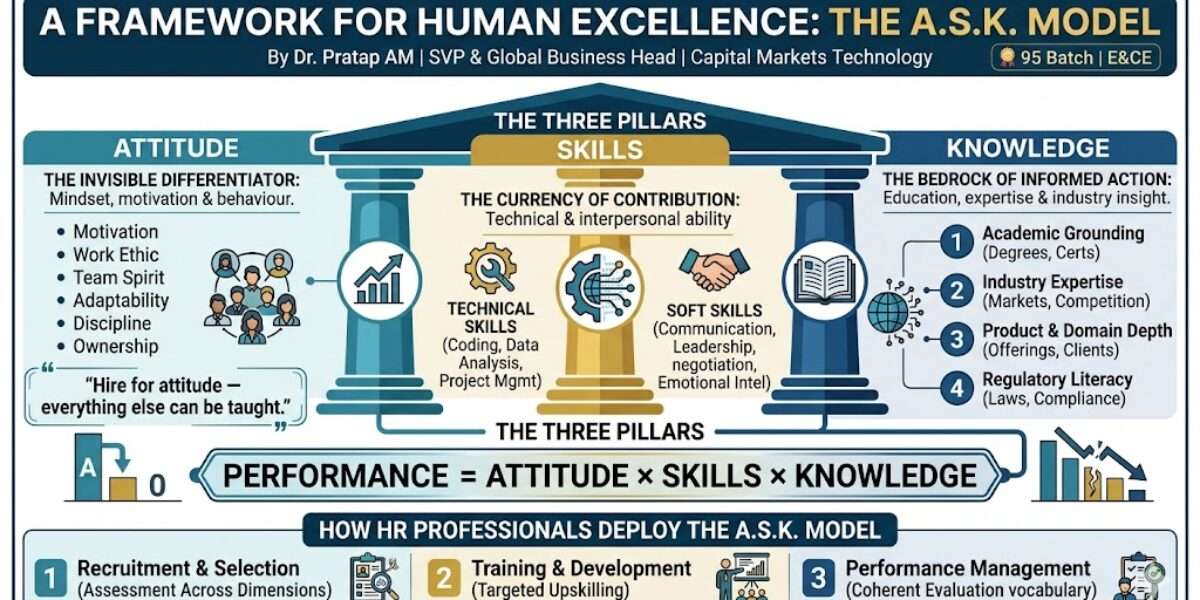
A Framework for Human Excellence in People Development
In over two decades of leading global technology business operations, I have interviewed hundreds of professionals, built cross-continental teams, and navigated the full spectrum of organisational challenges. Time and again, one fundamental truth has emerged: technical brilliance without the right mindset is a wasted asset. This conviction led me to the A.S.K. Model — a deceptively simple, profoundly effective framework that has since become central to how we recruit, develop, and lead at my organisation.
A – Attitude: Mindset, motivation & behaviour
S – Skills: Technical & interpersonal ability
K – Knowledge: Education, expertise & industry insight
Performance = Attitude × Skills × Knowledge
This multiplicative relationship carries a critical message: if Attitude falls to zero, performance collapses entirely — regardless of how high Skills and Knowledge may be. No degree of technical sophistication compensates for a corrosive or disengaged mindset.
Understanding the Three Pillars
Pillar One: Attitude — The Invisible Differentiator
Of the three pillars, Attitude is simultaneously the hardest to quantify and the most consequential. It encompasses the psychological orientation an individual brings to work — how they respond to setbacks, whether they energise or drain those around them, and whether they engage with complexity through curiosity or avoidance. Two professionals with identical qualifications will produce dramatically different outcomes based on this dimension alone. In global teams — the kind I operate across our organisation — attitudinal alignment is the thread that holds distributed talent together across geographies, time zones, and cultural differences.
“Hire for attitude — everything else can be taught.”
Pillar Two: Skills — The Currency of Contribution
While Attitude sets the foundation, Skills determine the quality of execution. They represent the practical, demonstrable competencies a professional applies to real problems. Unlike Attitude, skills can be directly taught, observed, and measured — making them the primary focus of structured training and development programmes. These include both technical and interpersonal abilities, as defined earlier, which must coexist for sustained professional effectiveness.
At our organisation, we invest deliberately in both. Technical upskilling keeps delivery teams globally competitive; leadership programmes ensure client-facing professionals translate complex solutions into business value. The most gifted engineer who cannot communicate remains underutilised.
Pillar Three: Knowledge — The Bedrock of Informed Action
Knowledge is the intellectual architecture upon which skills are practised and attitudes contextualised. An HR professional navigating a complex dispute may demonstrate admirable composure — but without command of labour law and organisational policy, even good intentions create exposure. Knowledge is not background enrichment; it is the operating system upon which everything else runs.
How HR Professionals Deploy the A.S.K. Model
The A.S.K. Model’s strength lies in its versatility across the complete employee lifecycle. From recruitment through to succession planning, this framework offers a coherent vocabulary for every human capital decision an organisation must make.
1. Recruitment & Selection
2. Training & Development
3. Performance Management
4. Succession Planning & Leadership Development
Performance Profiles at a Glance
This highlights a vital insight: strong attitude in the presence of lower skills and knowledge identifies a high-potential candidate who will return the investment in their development many times over.
A C-Suite Perspective: Leading with A.S.K.
The A.S.K. Model is far more than an HR diagnostic. At its highest application, it becomes an organisational philosophy — one that shapes how leaders build teams, design cultures, and define what professional excellence genuinely looks like. Three durable principles have guided my own practice in global business leadership:
* Hire for Attitude
* Train for Skills
* Educate for Knowledge
“The best investment any organisation can make is not in infrastructure or technology — it is in developing people who think, adapt, and grow.”
Closing Thoughts
The A.S.K. Model endures because it captures a truth no process engineering can circumvent: organisations are built by people, and people are more than their credentials. Across 28 years in Sales and Business Development within Capital Markets Technology, the teams I am most proud of were assembled not by chasing impressive records, but by seeking individuals with the right attitude, investing purposefully in their skills, and creating environments where the pursuit of knowledge never became optional. Whether you are an HR leader, a line manager, or a student stepping into your first role — the A.S.K. framework offers a clear and human lens on what professional excellence genuinely looks like. Attitude comes first. Everything else follows.
About the Author
Dr. Pratap AM is a 1995 alumnus of the Electronics & Communication Engineering programme and holds a PhD in Artificial Intelligence. With 28 years of experience in Sales and Business Development, he has built a distinguished career specialising in Capital Markets Technology sales and global business leadership. Currently serving as SVP & Global Business Head, he leads high-performance teams across geographies and is a recognised voice in enterprise talent strategy, technology-driven growth, and people-first leadership.