Wawa vs. H_2O: Inside the “Microwave Mind” of GenAlpha Student
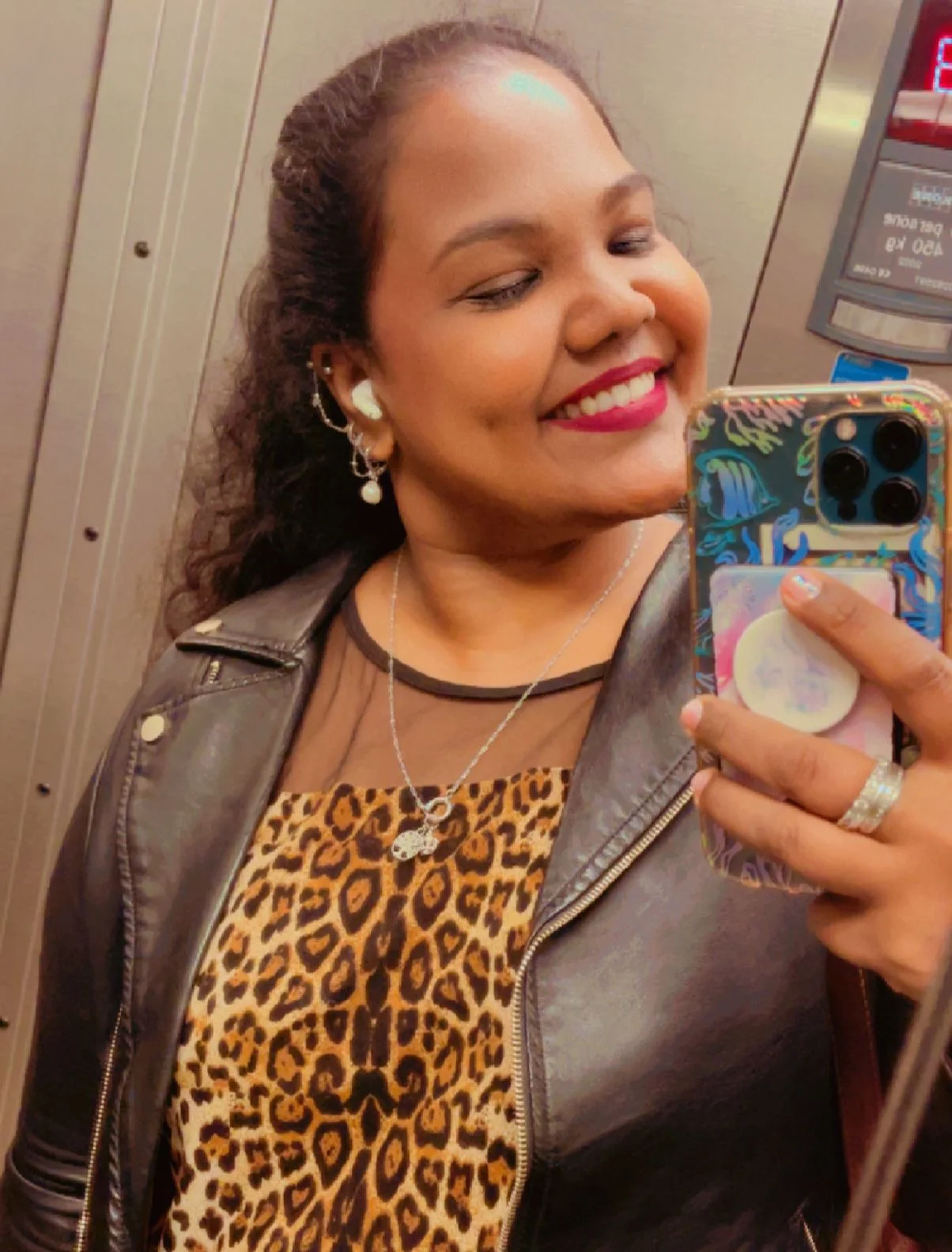
By Maestra Lincy/Chiara
English Teacher, Professional Clock-Translator, and Occasional Broadway Performer.
Disclaimer: What follows is not a double-blind longitudinal study. It’s simply what I have observed while teaching English in Italian public schools over the last five years. I have seen more than 1,000 children stare at clocks, forget basic elements, and occasionally levitate out of their chairs from sheer boredom. Take this as one tired teacher’s honest report from the front lines.
I teach English across the entire Gen Alpha spectrum in Italy, from primary school through high school. I’m the legendary “Prof. Lincy” or sometimes “Maestra Chiara” to my tiny tots because they decided my actual name wasn’t Italian enough and fondly rebranded me. To my high schoolers, I am just the woman standing between them and their next TikTok break.
Being an Indian teacher in an Italian classroom is a unique vibe. I come from a culture where “The Teacher” is treated as a mix of a deity and a drill sergeant. Now, I’m teaching a generation where “The Phone” is the ultimate deity, and I’m just the obstacle blocking their freedom to doomscroll endless reels on Instagram.
Not so long ago, I watched a student stare at an analog clock, tilt his head like a confused golden retriever, and announce with the absolute confidence of a CEO: “Prof, it’s ten minutes to seven.“
It was 10:07. He didn’t just misread the time; he invented an entirely new timeline. But this isn’t just a quirky story about clocks. It’s an internal alarm that went off for a much deeper, more concerning rewiring of the Gen Alpha brain. We are seeing a massive shift toward “scattered attention” where the ability to focus on a single task is constantly eroded by digital notifications. To survive this as a teacher, I routinely have to jump around like a circus clown, balancing my self-respect with the desperate need to keep their brains from drifting away.
The Microwave Mind vs. The Reality of Thinking
There is a very specific flavor of exhaustion that only a teacher truly understands. It’s the “Microwave Mind” phenomenon: the realization that I’m no longer just teaching English; I’m performing emergency surgery on the mechanics of human thought.
We live in the era of the instant hit. From 15-second TikTok videos to ChatGPT doing all the heavy lifting, kids have been conditioned to believe that if a solution doesn’t appear in three seconds, the problem simply doesn’t exist. Their brains have become digital vending machines. They press a button, and if the snack doesn’t drop immediately, they start aggressively shaking the machine in frustration. The scientific literature calls this the “Google Effect” or digital amnesia. Essentially, our brains are now biologically inclined to forget information we assume we can just look up online later.
The Drama of the “Non Ho Capito”
A typical moment in my classroom goes like this: I ask a question, a student blinks at me with the vacant, glazed-over stare of a laptop stuck on a software update since 2022. Then comes the dreaded phrase: “Non ho capito” (Italian: “I don’t understand”).
So, I repeat the question, using simpler words. I perform a one-woman Broadway musical complete with impressive dance and dramatic hand gestures just to convey a basic sentence. The response? It’s met with a shrug and a repeated, “Non ho capito.”
By the third time, I have to pause the lesson and channel my inner “Strict Indian Auntie”: fluent in both English and judgmental Italian. I look at them and say, “Listen to me. You aren’t actually looking for a solution; you’re just waiting for an instant door delivery. To find the answer, you first have to stop ghosting the problem.”
A Funeral for the “Slow-Cooker” Brain
The “Slow-Cooker” approach — the willingness to let a complex thought simmer until it’s tender — is officially on the endangered species list. Today’s students are struggling with a few major deficits:
Zero Curiosity: They rarely ask “Why?” Instead, they ask “What do I need to scribble here to get a 10?”
Zero Imagination: If a story doesn’t come with a vivid, high-definition image, their mental screen remains pitch black or like the grey thumbnail of someone who just blocked you on social media.
Zero Grit: At the first sign of a linguistic knot, they don’t try to untie it. They just say “Boh!”, throw it aside, and walk away, or sometimes even want to set the whole string on fire. (For the uninitiated, “Boh” is that beautiful, catch-all Italian interjection that means “I don’t know, I don’t care, and I have no intention of finding out.”)
I try to explain to them that understanding the question is 90% of the battle. If you don’t understand the problem, you aren’t solving anything; you’re just throwing darts at a board in a pitch-black room.
Lately, I’ve been forcing them to sit in the itchy, uncomfortable silence of not knowing. I tell them, “Do not give me that ‘I don’t understand’ excuse. Tell me exactly which word you didn’t get. Tell me where the logic tripped and fell. Show me the bruise.”
I am desperately trying to move them away from Microwave Thinking — which is instant, mushy, and usually freezing cold in the middle — and towards Authentic Problem Solving, which takes time, requires heat, and actually tastes like something. This mushy thinking is a direct result of cognitive offloading: the brain simply stops trying to process difficult information because it assumes a device will eventually do it for them (e.g., ChatGPT or Gemini).
Trust me, I have received copy-pasted homework from AI bots, even without any further editing of “Certamente! Il Simple Present (il presente indicativo inglese) è uno dei tempi verbali più importanti, ma fortunatamente è anche uno dei più semplici da imparare. Ecco una guida chiara e schematica per fare benissimo i tuoi compiti.” (Absolutely! The Simple Present (the English present indicative) is one of the most important verb tenses, but fortunately, it’s also one of the easiest to learn. Here’s a clear and concise guide to help you do your homework well.)
Why Curiosity is the Real H₂O
In 2026, my biggest job isn’t teaching the Present Perfect or explaining why “make” and “do” are different flavors of grammatical pain. It’s teaching them how to stay in the room with a difficult thought. Curiosity is the battery of intelligence. Without it, a student is just a $1,200 smartphone with a 0% battery: sleek, expensive, and totally useless. They need to learn to poke the problem, turn it over, and find the solution through their own sweat, rather than waiting for a pre-packaged, ready-to-eat answer to be dropped into their laps.
The Goldfish and the Dopamine Loop
You’ve probably heard the statistic that human attention spans have dropped to eight seconds, shorter than that of a goldfish. Teachers don’t argue with this data: we live it every day.
Here’s what an average morning looks like:
8:00 AM: I say, “Good Morning! What did we do last class?”
8:00 AM + 4 seconds: Three kids stare at me. Two put their hands up to ask for a bathroom break. One is drawing a TikTok logo on his arm or a ’67’.
8:00 AM + 90 seconds: A hand shoots up. “Miss, finito?” (Italian: “Finished?”)
Studenti! We haven’t even written the date yet! This is what a brain trained for a Dopamine Loop looks like: a constant chemical reward system triggered by notifications and likes that makes boring reality feel physically unbearable.
The “Wawa” Incident
Last year, I asked my third-year middle school students a simple question: “What’s the chemical formula for water?” Total silence…. I turned to the board and wrote H₂O. A boy in the back suddenly shouted, “Beh, Sì! Acca-e-oh!” (In Italian, ‘H’ is ‘acca’ and ‘O’ is ‘oh’). When he blurted it out quickly, it sounded exactly like “Wawa,” like a toddler asking for a feeding bottle.
These kids aren’t less intelligent than previous generations; they’ve just outsourced their memory to the cloud. But as I tell them, you can’t cook a risotto or a biryani if the rice isn’t actually in your own pantry.
The Real Culprit: The Bedroom Phone
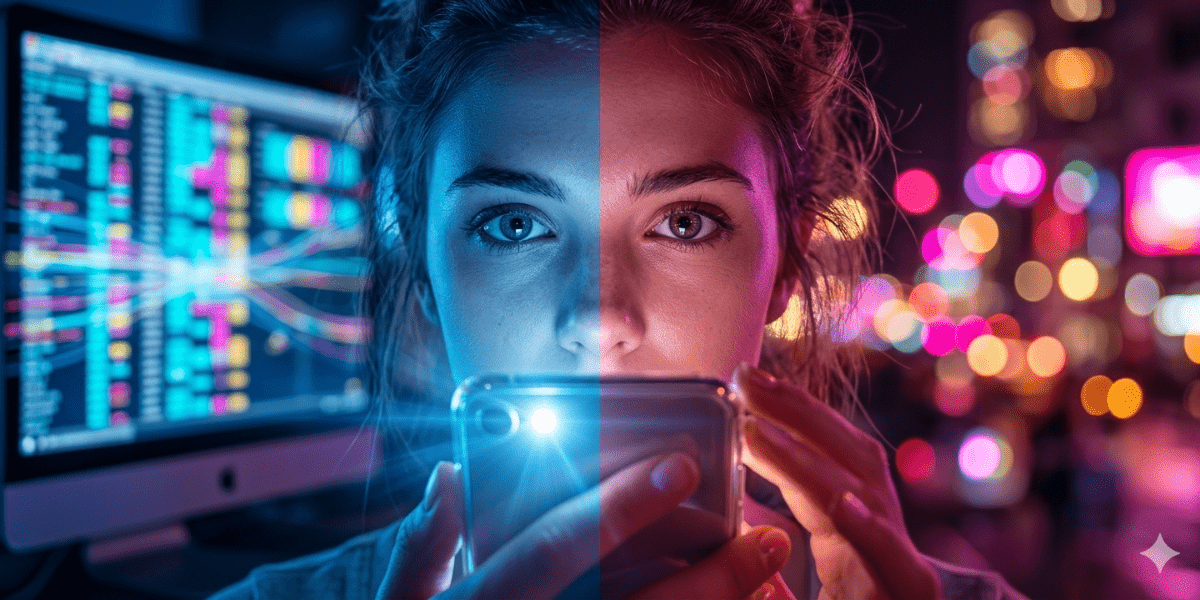
After five years of observing this, I’ve noticed a distinct pattern: the kid who sees a portal to another dimension instead of 10:07 is almost always the one whose phone “sleeps” right next to their bed. Blue light suppresses melatonin, and in children, this effect is nearly twice as strong as it is in adults. A phone screen at 10:00 PM hits a child’s brain like four shots of espresso. They aren’t being “lazy” the next morning; they’re biologically hungover. A foggy, sleep-deprived brain has zero grit. It demands the microwave answer because it simply doesn’t have the metabolic energy to hunt for the real one.
Maestra Lincy’s Classroom Survival Guide
To combat the fog, I’ve had to develop a few non-traditional teaching strategies:
The Sticker Economy: I give out stickers and stamps for correct answers. You would be amazed to see a cynical, 17-year-old Italian teenager fight to the death for a shiny star sticker or stamp. So, most of the time, I look like Mary Poppins with her magic bag of infinite stickers or stamps!
The “Explain the Absurdity” Rule: When a student tells me it’s “10 to 7” at 10:07, I make them walk up to the clock, point at the hands, and talk me through the logic. I force them to stay in the room with the mistake, relearn, and correct themselves. I encourage them to make mistakes, because every failure is a stepping stone to success and it would help me to know where they are going wrong, teach them again and help them learn better. Of course, I have developed ocean-depth patience by now.
The Boredom Bell: Sometimes I tell them, “For the next five minutes, you are going to be bored. Just sit there and feel it.” For sure, I hear the symphony of disappointed “NOs!” Well, the fact is that students nowadays don’t know how to be bored, or are not brave enough to let themselves be bored and think of things to engage themselves other than reaching out for their phones to kill their boredom. Creativity lives in the waiting room of boredom, but modern life has completely demolished the waiting room.
The Honest Truth
Despite the venting, my students are genuinely magnificent. They can negotiate like seasoned UN diplomats, and just the other day, a student connected a poem about a lonely tree to “the feeling of having 0% battery” in a heartbeat. That is empathy. That is real intelligence.
They aren’t broken; they’ve just been rewired. But as a teacher, I know that anything that was wired can be rewired. We just have to stop feeding them ready-to-eat answers. We have to teach them to love the struggle of the puzzle again — one sticker, one analog clock, and one slow-cooked thought at a time.
Now, if you’ll excuse me, I need to explain to a teenager that H₂O is a molecule, not a new streetwear brand.
With Love,
Maestra Chiaretta
Scientific References & Further Reading
* Gong, C., & Yang, Y. (2024). Google effects on memory: A meta-analytical review of the media effects of intensive Internet search behavior. Frontiers in Public Health, 12, 1332030. [https://doi.org/10.3389/fpubh.2024.1332030](https://doi.org/10.3389/fpubh.2024.1332030)
[https://pmc.ncbi.nlm.nih.gov/articles/PMC10830778/](https://pmc.ncbi.nlm.nih.gov/articles/PMC10830778/)
* Pilat, D., & Krastev, S. (2021). Google effect. The Decision Lab. Retrieved May 17, 2026, from [https://thedecisionlab.com/biases/google-effect](https://thedecisionlab.com/biases/google-effect)
* The Blue Light Impact: A parent-friendly guide by the Sleep Foundation explaining exactly why bedroom screens are “biological coffee” for kids: [https://www.sleepfoundation.org/children-and-sleep/how-blue-light-affects-kids-sleep](https://www.sleepfoundation.org/children-and-sleep/how-blue-light-affects-kids-sleep)
* Sharpe, B. T., & Spooner, R. A. (2025). Dopamine-scrolling: A modern public health challenge requiring urgent attention. Perspectives in Public Health, 145(4), 190-191. [https://doi.org/10.1177/17579139251331914](https://doi.nlm.nih.gov/articles/PMC12322333/)
[https://pmc.ncbi.nlm.nih.gov/articles/PMC12322333/](https://pmc.ncbi.nlm.nih.gov/articles/PMC12322333/)
* Schilhab, T. S. S., Stevenson, M. P., & Bentsen, P. (2018). Contrasting Screen-Time and Green-Time: A Case for Using Smart Technology and Nature to Optimize Learning Processes. Frontiers in Psychology, 9, 773. [https://doi.org/10.3389/fpsyg.2018.00773](https://doi.org/10.3389/fpsyg.2018.00773)
[https://pmc.ncbi.nlm.nih.gov/articles/PMC5992484/](https://pmc.ncbi.nlm.nih.gov/articles/PMC5992484/)